Scholarship help: the honest answers
Most college money comes from the colleges themselves and from one free form, the FAFSA, not from scholarship websites. The guides below, drawn from the book Scholarships, Figured Out, cover where the money really is, how to find local awards, how to avoid scams, and how to keep a win from cutting your aid.
Where should I start?
Are there really billions of dollars in unclaimed scholarships?
No. The "billions unclaimed" claim traces back to a 1976 study of employer tuition benefits, not scholarships students could apply for. Truly…
Do I Need to File the FAFSA to Get Scholarships?
Often, yes. Many colleges and private scholarships require a filed FAFSA before they will award their money, including merit aid that has nothing to…
How do I find local scholarships?
Start by asking your school counselor for the list of local scholarships, then search your city or county name plus “community foundation.” Next,…
How do I spot a scholarship scam?
Use one rule: real scholarships pay you, and you never pay them. Any application fee, processing fee, redemption fee, holding deposit or upfront tax…
Can I use AI (ChatGPT) to write my scholarship essay?
You can, but you shouldn't. Many scholarship providers screen for AI, some programs disqualify AI-written applications outright, and a flag lands you…
Can winning a scholarship reduce my financial aid?
Yes. It's called scholarship displacement: you report an outside scholarship, and your college reduces its own aid by the same amount, so your bill…
How do I apply and win?
How do I compare financial aid offers?
Sort each offer into free money (grants and scholarships) and everything else (work-study and loans), then compare what each school will actually…
Scholarships for high school seniors: where to look and when to apply
High school seniors should file the FAFSA as early in the fall as possible, get their counselor’s local scholarship list in September, and apply…
How do I write a scholarship essay that wins?
Tell one specific, true story only you can tell. Open inside that moment, answer the prompt directly and early, then connect the story to your…
Scholarships for adults going back to school: where the money really is
Adults going back to school have more funding options than teenagers, not fewer. Ask your employer first (up to $5,250 a year tax-free), file the…
What free tools are there?
- The 100 Scholarships: the book's starter list, free on the page, with no email or account.
- The full 2027-28 Scholarship Directory: 1,500+ verified programs checked against the sponsors' own sites in September 2026 ($40).
- AppDeadline: a countdown planner for every college deadline, document and essay.
Which guide should I read first?
If you are not sure whether scholarship money is real, start with the guide on whether billions of dollars sit unclaimed, then the one on whether you need to file the FAFSA to get scholarships. If you want to find awards near home, read how to find local scholarships. If an offer asks you to pay, read how to spot a scholarship scam before you send anything.
What if I already have offers or awards?
Read how to compare financial aid offers, which sorts each offer into free money (grants and scholarships) and everything else (work-study and loans). Then read whether winning a scholarship can reduce your financial aid, so an outside award does not quietly cut what a school gives you.
Is there a guide for my situation?
There are separate guides for high school seniors, who should file the FAFSA as early in the fall as possible, and for adults going back to school. There are also guides on writing a scholarship essay and on whether you can use AI to write one.
Is this financial advice?
No. These are general guidance, not individualized financial, legal or tax advice. Rules, deadlines and figures change, so confirm current details with the school or the sponsor before you act.
Where do these answers come from?
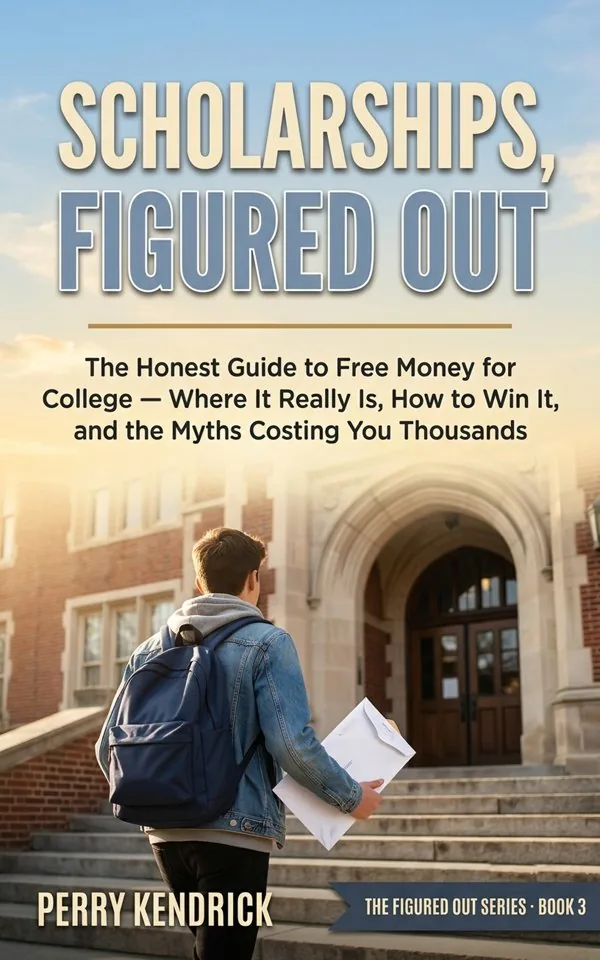
The honest guide to free money for college: where it really is, how to win it, and the myths costing families thousands. Book 3 of the Figured Out series.
General guidance, not individualized financial, legal or tax advice.
Sources
Official and primary sources on the topic. Rules, deadlines and figures change, so confirm current details there before you act.
- How To Avoid Scholarship and Financial Aid Scams (Federal Trade Commission). Describes common scholarship and financial aid scam tactics, such as upfront fees and fake contests, and how to report fraud.
- Counselors and Mentors Handbook on Federal Student Aid (U.S. Department of Education, Federal Student Aid). Guide for advisors on the 2027-28 FAFSA, the free Department of Labor scholarship search, reporting outside awards, and never paying to file.
- Trends in Student Aid: Highlights (College Board Research). Summarizes 2024-25 student aid, including $85.1 billion in institutional grant aid, federal and state grants, and loan trends.