How do I spot a scholarship scam?
Use one rule: real scholarships pay you, and you never pay them. Any application fee, processing fee, redemption fee, holding deposit or upfront tax payment means it is a scam. Other red flags include guaranteed wins, awards for contests you never entered, requests for bank or card numbers, secret information and fake urgency.
What is the one rule that stops most scholarship scams?
The one rule is simple: real scholarships pay you, and you never pay them. In Scholarships, Figured Out, that single rule is described as beating ninety percent of scams by itself.
That means no application fee, no “processing fee” to release your award, no “redemption fee,” no “holding deposit,” and no taxes paid up front to an office you have never heard of. The moment anyone asks you to send money in order to receive scholarship money, you are looking at a scam dressed up as a scholarship.
Legitimate providers spend money to give it away. They don’t charge admission. Wherever families are stressed about money, scammers show up, so keep this rule in mind every time an offer lands in your inbox.
What are the red flags of a scholarship scam?
Scholarship scams run on the same handful of tricks, and they repeat like a bad song. The book’s red-flag list is adapted from the Federal Trade Commission’s consumer guidance on scholarship and financial aid scams.
| What the scammer says | Why it gives them away |
|---|---|
| Any fee to apply, process, redeem or hold your award | Real scholarships pay you. You never pay them. |
| “Guaranteed or your money back” | Nobody can guarantee you a scholarship. The ones who promise to plan to keep the fee and vanish. |
| “You’ve been selected” for a contest you never entered | If you didn’t apply, you didn’t win. |
| “We just need your bank account or card number to hold your award” | No real provider needs your bank information to give you money. Checks and school-disbursed funds work fine. |
| “Exclusive information you can’t get anywhere else” | Every legitimate scholarship wants to be found. Secrecy is a sales tactic. |
| “Act now, spots are filling” | Real deadlines are dates on a website, not countdown timers in a pushy phone call or DM. |
Once you can recognize these patterns, you are close to immune. Scholarship scams take millions of dollars from families every year, often from the families who can least afford the loss.
How can I check whether a scholarship offer is legitimate?
Check any offer against a short list of questions before you share information or money. Nearly every scholarship scam fails at least one of them.
- Are they asking me to pay anything? If yes, walk away. Real scholarships pay you.
- Did I actually apply? If you didn’t apply, you didn’t win.
- Do they want my bank or card number? No real provider needs it to give you money.
- Can I find it on the sponsor’s own website? Every legitimate scholarship wants to be found, and the sponsor’s site is where you confirm this year’s deadline and rules.
- Is the deadline a date or a countdown? Real deadlines are published dates, not pressure in a phone call or DM.
If an offer passes every question and still feels off, don’t decide alone. Bring it to your school counselor and ask for a second look.
Are paid scholarship search services a scam?
Paid scholarship search services that charge hundreds of dollars are a softer hustle, even when they aren’t technically a scam. They will technically search, but searching is not the hard part, and you can do it free in an afternoon on the big databases, in your own community and in niche categories.
The book’s advice is short: don’t pay for a list. There are honest paid tools that earn their keep on curation and verification, such as checking deadlines, weeding out dead listings and organizing the mess.
The difference is what you are paying for. Organized, verified information is a fair product. “Access” to free money never is.
Do scholarship websites sell your information?
Some do. Reporting by The Hechinger Report documented major scholarship-search sites sharing student information with marketers, which is why your inbox can fill with college mailers, loan pitches and “special offers” two weeks after you sign up.
The big databases are still free, legitimate and worth using. The fix is to protect yourself before you register:
- Create a separate email address just for scholarship hunting. Every application, database profile and contest entry goes through it, so your real inbox stays clean.
- Verify every listing on the sponsor’s own website. Databases go stale, so spend two minutes confirming this year’s deadline and rules before you invest an hour.
- Treat social media as leads, not facts. CNBC reported in 2026 on research finding that roughly one in three students hunting for scholarships on TikTok runs into misleading content.
Where do I report a scholarship scam?
Report a scholarship scam at ReportFraud.ftc.gov, the Federal Trade Commission’s fraud site. Then tell your school counselor so they can warn other families.
There is no shame in reporting, whether you spotted the scam or got hit by it. These operations are professionally slick, and they fool smart people every year.
If you are unsure about an offer, show it to an adult who has seen a lot of these, ideally your counselor, and ask, “Does this look right to you?” Scammers count on teenagers being too embarrassed to ask, so asking is the cheapest protection there is.
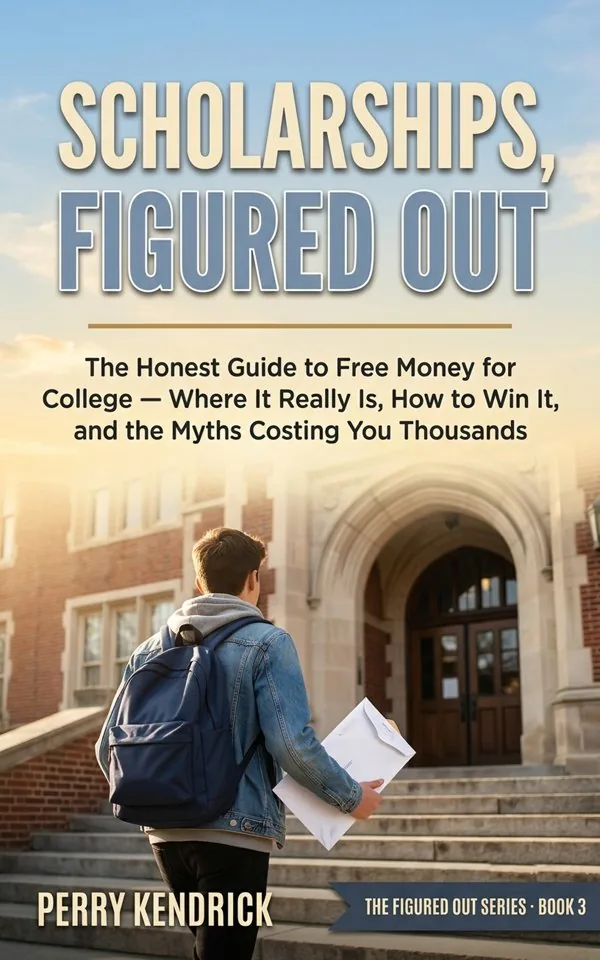
The whole system, in one book
This article covers the scam warnings from Chapter 7, "Smell the Scam," and the data-selling advice from Chapter 4, "The Big Nets." The full book, Scholarships, Figured Out, walks through where the real money is, how to file the FAFSA, how to find local and niche awards with small applicant pools, and how to build an application system that wins, with the research behind every number printed in the back.
Want every award, not just 100? The full 2027-28 directory covers 1,500+ verified programs checked against the sponsors' own sites in September 2026 ($40).
Frequently asked questions
Is it a scam if I was told I won a scholarship I never applied for?
Almost certainly, yes. Real scholarship awards don't work that way: if you didn't apply, you didn't win. A message saying you've been selected for a contest you never entered is one of the classic scam red flags, especially if it then asks for a fee, a deposit or your bank details.
Do I have to pay taxes before I can receive a scholarship?
No. Being asked to pay taxes up front to some office you've never heard of is a scam red flag. Real tax questions come later: most scholarship money spent on tuition, required fees, books and supplies is tax-free, while money used for room and board is taxable. Check IRS Tax Topic 421 at irs.gov.
Can a real scholarship ask for my bank account or card number?
No legitimate scholarship provider needs your bank account or card number to give you money. Awards are paid by check or disbursed through your school, and both work fine. A request to hold your award with your card or account number is a red flag, so stop and report it at ReportFraud.ftc.gov.
Is scholarship advice on TikTok reliable?
Treat it with caution. CNBC reported in 2026 on research finding that about one in three students hunting for scholarships on TikTok runs into misleading content, including hype, half-truths and recycled myths. A short video is built to be shared, not to be right, so use it for leads and verify everything on the sponsor's site.
What should I do if I already paid a scholarship scammer?
Report it at ReportFraud.ftc.gov, the Federal Trade Commission's fraud site, and tell your school counselor so they can warn other families. Don't be embarrassed. These operations are professionally slick and fool smart people every year. Going forward, keep one rule: real scholarships pay you, and you never pay them.
More scholarship help
Sources
- Federal Trade Commission. How To Avoid Scholarship and Financial Aid Scams. consumer.ftc.gov
- The Hechinger Report. Reporting on scholarship websites and student data. hechingerreport.org
- Internal Revenue Service. Tax Topic 421 — Scholarships, Fellowship Grants, and Other Grants. irs.gov
General guidance from Scholarships, Figured Out, not individualized financial, legal or tax advice. Rules and deadlines change; confirm them with the program or your school's financial aid office.
Sources
Official and primary sources on the topic. Rules, deadlines and figures change, so confirm current details there before you act.
- How To Avoid Scholarship and Financial Aid Scams (Federal Trade Commission). Describes common scholarship and financial aid scam tactics, such as upfront fees and fake contests, and how to report fraud.
- Types of Aid and Eligibility (U.S. Department of Education, Financial Aid Toolkit). Explains federal, state, school and private aid, eligibility, scam avoidance, and where to find free scholarship searches.
- Counselors and Mentors Handbook on Federal Student Aid (U.S. Department of Education, Federal Student Aid). Guide for advisors on the 2027-28 FAFSA, the free Department of Labor scholarship search, reporting outside awards, and never paying to file.