Trade school vs college: how do you decide which is right for you?
Neither path is automatically smarter. Trade school or an apprenticeship costs far less and gets you earning in months to two years, often debt-free, but pay can plateau and the work is physical. College costs more and takes four-plus years, but opens more doors long term. Choose by fit, not prestige.
What is the difference between trade school and college?
College teaches you about a subject; a trade teaches you to perform one. A four-year college or university takes roughly four years and ends in a bachelor’s degree, while a trade is a job built on a specific, hands-on skill you learn by doing it.
There are two main doors into a trade. Trade school (also called vocational school or technical college) strips school down to the job skill, usually in a few months to two years, and ends in a certificate, diploma or associate degree. An apprenticeship hires you from day one, pays you while you train under experienced pros, and ends in a nationally recognized credential.
Many trades, such as electrician, plumber, HVAC and dental hygiene, also require a state license. That usually means passing an exam and logging a set number of supervised hours.
One myth to drop right away: the trades are not where you go if you “couldn’t handle” college. Several trades out-earn the average college degree. A trade is a different path, not a lesser one.
Who is college a good fit for, and who is trade school a good fit for?
The dividing line is fit, not intelligence. Some sharp, straight-A students belong in the trades, and some average students thrive in college.
College tends to fit you if:
- Your career requires a degree, such as nurse, teacher, engineer, accountant, doctor, lawyer or physical therapist
- You enjoy going deep on ideas, words and problems on a page
- You can be patient for a payoff that is a few years out
A trade tends to fit you if:
- You come alive building or fixing something real and like pointing at finished work
- Waiting four-plus years and borrowing before you earn makes you restless
- You would rather move all day than sit at a desk
Think twice about college if the only reason you can name is that it is expected, or if you would borrow heavily just to figure out what to study. Think twice about a trade if what lights you up lives in your head, or if decades of physical work sound like a cost you do not want to pay.
Is trade school cheaper than college?
Yes, usually by a wide margin. A trade-school program typically runs around fifteen thousand dollars total, with some as low as five thousand and some up toward thirty for longer programs.
College has to be judged by its net price, meaning what you pay after grants and scholarships, not the sticker price. At a public in-state university, the full sticker cost of attendance is roughly thirty thousand a year, but the average in-state student pays closer to twenty-one thousand a year all in. A private college can top sixty thousand a year in sticker cost, while the average student there often pays closer to thirty thousand after aid.
An apprenticeship flips the math entirely: you get paid to learn. Apprentices usually start at something like forty to fifty percent of a fully qualified journeyman’s wage and are often up around eighty or ninety percent by the final year, usually with no debt at all.
Time is part of the price too. A college student spends four years mostly not earning, while someone in a trade can be earning within months to two years.
These figures are mid-2026 ballparks, current as of June 2026. They drift every year, so use them to compare the paths, then check current numbers for the specific schools and programs you are considering.
Who earns more, tradespeople or college graduates?
On average, college graduates earn more over the long run, but the trades pay well and pay sooner. Someone with a bachelor’s degree earns around eighty thousand dollars a year on average, compared with closer to forty-eight thousand for someone with only a high school diploma.
That average hides a big spread by major. Engineering, computer science, nursing, finance and accounting graduates routinely start in the high seventies to low eighties, while graduates in some other fields start below what a skilled tradesperson makes.
Trade wages are strong. According to the government’s wage data, typical (median) pay looks like this:
- Dental hygienists: around ninety-four thousand a year
- Electricians and plumbers: the low sixties, with the top tenth clearing a hundred and five thousand
- HVAC technicians: the high fifties to low sixties
- Auto mechanics: just under fifty thousand; welders just over it
The catch is the ceiling. Trade pay tends to start strong and then flatten, and the jump from good to great usually comes from a deliberate move: specializing, supervising, going union or owning the business. A degree, meanwhile, tends to open more doors over a whole career, but only if you finish it.
What are the downsides of college and of trade school?
Each path has a real downside the brochures skip. For college, it is not finishing: more than a third of people who start a bachelor’s degree have not finished six years later.
The worst outcome in the book is borrowing for college and leaving without the degree. That person carries a graduate’s debt with a non-graduate’s earning power. The damage usually comes from three things lining up: borrowing heavily, for a field that does not pay much, and then not finishing.
For the trades, the biggest cost is your body. Knees, backs, shoulders and hearing take the brunt over the years, and injuries are a real risk. Pay can plateau if you never climb, state licenses often do not transfer when you move, and a deep but narrow skill can make a total career change feel like starting over.
Neither list makes either path bad. Both are paths with trade-offs you should see clearly before you commit.
How do I decide between trade school and college?
Decide by matching each path’s trade-offs to what you value most. Nobody wins every category, as this side-by-side shows:
| College | Trade school or apprenticeship | |
|---|---|---|
| Up-front cost and debt | Highest cost and highest debt risk | A fraction of the cost; apprenticeships pay you |
| Time to a paycheck | Four or more years | Immediate (apprenticeship) to two years |
| Long-term ceiling | Highest for many careers, especially degree-gated ones | High for those who specialize or own the business |
| Physical demand | Low | A steady toll that adds up over decades |
| Flexibility | Widest range of doors; easy to switch majors | Deep but narrow |
| How you get in | Applications, essays, FAFSA, commit by May | Enroll, or apply to a competitive apprenticeship |
Then ask yourself a few honest questions, and write down which path each answer points to:
- Does four more years of school appeal to you, or make something in you sink?
- Do you come alive making and fixing physical things, or around ideas and problems on a screen?
- Do you want to be earning soon, or are you willing to borrow now for a bigger payoff later?
- How do you feel about physical work and its long-term toll?
Finally, finish this sentence: “I’m drawn to this because…” If your only honest answer is “because I’m supposed to,” you still need a real reason before you commit.
If your answers come out split, community college is a smart low-risk first move. It can be a cheap launch pad toward a bachelor’s degree or a low-cost on-ramp into a trade. The military is another path the book covers in full.
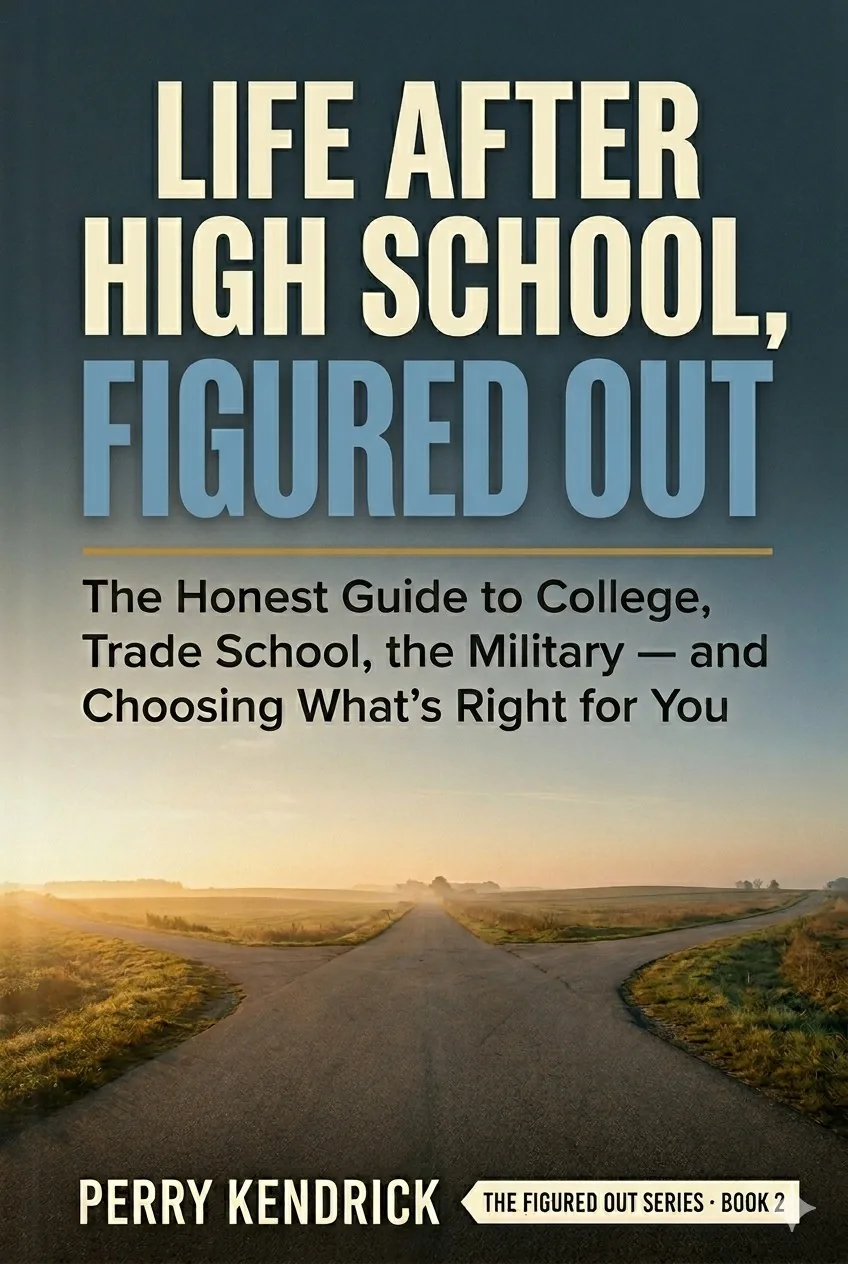
The whole picture, in one book
Life After High School, Figured Out gives college and the trades a full section each, from Chapter 7’s net-price walkthrough and Chapter 15’s trade-wage ceiling to the honest downsides in Chapters 11 and 17. It then lines up every path in Chapter 27 and walks you through the full seven-question Decision Worksheet in Chapter 28, along with chapters on the military, community college and building your own business.
Frequently asked questions
Can I start learning a trade while still in high school?
Often, yes. Many high schools run Career and Technical Education (CTE) programs and shop classes, and some offer dual enrollment that lets you earn community-college trade credits as a senior. Pre-apprenticeship programs also exist. Done early, you can graduate already holding certifications, skills and connections, sometimes for free.
How do I find a registered apprenticeship?
Search apprenticeship.gov, a free federal website that lists registered programs by trade and location. Registered Apprenticeships are tracked by the U.S. Department of Labor and meet real standards. Local unions also run respected apprenticeships with solid pay and benefits, and a phone call to a union hall or technical college often turns up more than hours of searching.
Is community college a good middle ground between trade school and college?
It can be. You can do your first two years at community-college prices and transfer to finish a bachelor’s degree, cutting the cost of college roughly in half. Many technical and career programs also run out of community colleges. The catch is planning the transfer so your credits actually carry over.
Can I switch from a trade to college later, or the other way around?
Yes. People complete a trade, work it for years and then earn a degree on top of it, and college graduates sometimes discover they love hands-on work and learn a trade. The door behind you does not lock. Changing course with a real reason, after learning something about yourself, is growth, not failure.
How much do college graduates usually borrow?
Nearly four in ten students who earn a bachelor’s degree borrow nothing at all. Those who do borrow finish owing somewhere around thirty-five to forty thousand dollars on average. A useful rule: do not borrow more, in total, than you expect to earn in your first year out of school.
More from the Figured Out series
Sources
- the College Board’s annual Trends in College Pricing report
- the U.S. Department of Education’s College Scorecard
- the National Center for Education Statistics
- the U.S. Bureau of Labor Statistics Occupational Outlook Handbook
- the U.S. Department of Labor’s apprenticeship program (apprenticeship.gov)
General guidance from Life After High School, Figured Out, not professional financial, legal, career or enlistment advice. Figures change; confirm current numbers with official sources before you decide.
Sources
Official and primary sources on the topic. Rules, deadlines and figures change, so confirm current details there before you act.
- Education pays (U.S. Bureau of Labor Statistics). Table of 2025 unemployment rates and median weekly earnings for adults 25 and over by highest education level completed.
- Electricians : Occupational Outlook Handbook (U.S. Bureau of Labor Statistics). Profile of electricians' duties, training and licensing paths, pay and job growth; typical entry education is a high school diploma.
- COE - Price of Attending an Undergraduate Institution (National Center for Education Statistics). Reports total cost, tuition and fees, net price and grant aid for full-time undergraduates by institution type and family income.
- Education level and projected openings, 2024–34 : Career Outlook (U.S. Bureau of Labor Statistics). Ranks occupations by projected annual openings for 2024–34 across five education levels, with median wages and training requirements.